

OFFICE OF DISTURBANCE! ROLLATOR GRAPHIC AT ART MATTER WEEK
Rollator-graphic, dream bubbles and memory traces
During ARTMATTER-WEEK 2025, I organized an art workshop for the residents of Ørestad Care Center.
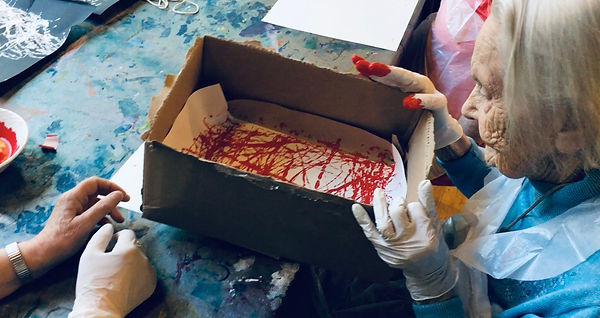
Over two creative days, residents, staff, and guests collaborated on a large abstract artwork inspired by play, movement, and imagination. We used playful techniques inspired by the COBRA group: rolling paint-covered balls and toys, blowing colored soap bubbles, and making prints with wheelchairs and walkers.
We opened an Office for Disturbance, inspired by COBRA artist Asger Jorn and his artistic resistance to fascism’s “Entartete Kunst” — its bans, rigid forms, and glorification of war. This also echoed the care center’s architecture, which was inspired by COBRA’s expressive spirit.
We drew blindfolded, discovered hidden shapes, and finally assembled the strongest elements into a framed collage. We did collect traces of experiences — and together we created a work of art for eternity.




ART PROFILE
Ørestad Care Center is a municipal nursing home, with 114 residents. located in Ørestad close to Kalvebod Fælled in Copenhagen, Denmark.
The care center was designed by Arkitektgruppen JJW and was inaugurated in 2012. It is a Profile Nursing Home For Art and Culture.
The Municipality of Copenhagen has 9 profile nursing homes that provide opportunities for communities between residents with the same interests.
The Municipality of Copenhagen's profile nursing homes help prevent loneliness and create more choices for Copenhageners who move to nursing homes.
At the same time, the profile nursing homes help meet the residents' individual needs and interests to an even greater extent than before - and create communities between residents who have the same interests.
ART AND COFFEE
This workshop was part of an ongoing artistic collaboration I’ve had with Ørestad Care Center over several years. For a couple of years, I taught a weekly class called Art and Coffee, where residents explored techniques in painting, drawing, and printmaking while engaging in talks about art history. I was also invited to create 21 paintings for the project Lifemarks on the Stairs (Livsaftryk på Trappen), based on conversations with residents about their lives.
Over two creative days, residents, staff, and guests collaborated on a large abstract artwork inspired by play, movement, and imagination. We used playful techniques inspired by the COBRA group: rolling paint-covered balls and toys, blowing colored soap bubbles, and making prints with wheelchairs and walkers.
GROWING OLDER AND STILL LIVING
We are all getting older. Life expectancy is increasing, and many of us will, at some point, live in a care home — often for several years. In Denmark, approximately 55,600 people lived in care homes in 2023. Among Danes over the age of 80, 12.2% live in residential care facilities. On average, people move into care at age 81, and they typically live there for about 2½ years.
This makes it essential to offer meaningful activities — so life doesn’t become a matter of simply waiting for the end, as if older people were merely being stored away. In a society that celebrates productivity, speed, and youth, the elderly risk becoming invisible. They are often excluded from the public eye, the workforce, and the cultural conversation.
So how can we create real interaction between generations? How can we see the elderly not as a burden, but as whole human beings — full of stories, emotions, creativity, and curiosity?
This is where art can play a vital role. When time slows down, art can open a new and meaningful space — for reflection, memory, sensory experience, imagination, and human connection. Through art, we can discover new ways of growing older. The elderly don’t just tolerate disruption — they welcome it.
Let’s be surprised. Let’s explore new paths into ageing. Yes, please.


COLLAGES BY MADELIN WILIAN IN COLLABORATION WITH RESIDENTS FROM ØRESTAD NURSINGHOME 2025
"CONTRAST SCREW" - "CORNER DISTURBED". 90x130 cm each.
ROLLATOR GRAPHICS AND DREAM TRAILS
On working with art with residents in nursing homes
At this year's Art Matter Festival, I am invited as a visual artist to lead a two-day art workshop with residents at Ørestad Nursing Home. Since the architects of their green-yellow building were inspired by the Cobra group, I draw inspiration from them as well. We will work with art in the way Cobra and Asger Jorn did. We will create an OFFICE FOR DISTURBANCE, aiming to awaken the residents from their "Sleeping Beauty sleep" through art.
We will experiment with printing graphic life-traces using the wheels of the residents’ walkers and wheelchairs. These wheels will be coated with color and rolled over old vintage wallpapers. We will conduct many wild art experiments in our "Disturbance Office."
Ørestad Nursing Home offers many art activities, as it is one of Copenhagen Municipality's profile nursing homes with art as its focus. The management is engaged in contemporary art and often invites it in with curiosity and special openness.
ROLLATOR COLOR CARVING, DREAM BUBBLES, AND MEMORY TRACES
“We gather traces of experiences and dreams and create a work of art for eternity.”
Participation is voluntary. A group of fifteen residents, eager and curious, gather around a table in the common room. They are of various ages and abilities. Many have previously worked in offices or factories. A few have dementia.
“Is Cobra a snake?” asks Ida, a former factory worker, unfamiliar with the art group.
WILD COBRA
COBRA was formed in 1948, just after World War II. The name comes from Copenhagen, Brussels, and Amsterdam, because the artists came from Denmark, Belgium, and the Netherlands. They were tired of the war’s darkness and the rigid rules of society — and of art. They wanted to create something new, lively, and spontaneous, something that could touch imagination and feelings.
They worked with painting, poetry, sculpture, and children's drawings — loving everything wild and direct. The COBRA artists painted with their whole bodies, used primitive signs, masks, and animals, and experimented with anything.
Jorn, for example, made a huge clay relief that he drove over with his scooter, so the wheels made tracks! We will do the same. A few residents with walkers and wheelchairs print their “life traces” over vintage wallpaper in the courtyard. “We’re wild!” murmurs Jan in a wheelchair with a crooked smile.
“Art doesn’t have to be pretty — it has to be alive!” I say, quoting Asger Jorn.
COLORFUL PLAY AND MEMORY SHARING
A group of giggling residents blow colored soap bubbles and shoot water pistols filled with paint onto large rolls of white paper. It becomes abstract, colorful trails and splashes.
We draw squiggles with crayons on paper, find imaginary creatures in them, and color them in.
The conversation flows around the art table. The residents recall the post-war period. A father who sold ice cream in Amager, a woman whose parents owned a dance restaurant called “White Star,” another whose parents died in concentration camps. Another’s father walked barefoot all the way home to Jutland as a survivor from a German camp at the end of the war.
The Cobra group believed children were the wisest — that it was adults who bombed each other and started wars. Children dream and play, also with colors and art. And art is for everyone! Not just for those with fancy frames and expert knowledge, said Asger Jorn.
“WE WANT TO BE DISTURBED!”
“We want to be disturbed!” says Kirsten, who has dementia and suddenly lights up when she dips a couple of balls into paint and spins them around on paper.
We throw words around, see where they land, and create new word images that become titles for our two collages of art experiments: “Edge Disturbed” and “Contrast Screw.”
“What is edge disturbed?” asks Ole, an engineer by profession.
“Well, it’s like bumping into lots of sharp edges,” says Helle, the nursing home’s culture pilot, who ensures paintings are borrowed from the municipality’s art library for the home.
The two collages will be framed and hung at the nursing home as memory traces for eternity.
A WHEELCHAIR ART PERFORMANCE IN BASEL 2026
The workshop with rollator/wheelchair graphics has also been commissioned for a BASEL cultural festival in 2026. Then Basel nursing home residents will be “disturbed” with wild art experiments and rollator color carving.
WHY DISTURBANCE?
It’s good to be disturbed in one’s habits and thought patterns. Maybe it can inspire new ways of seeing the world. Maybe it can change a bit of the old, rigid rules and cultures. Also as “edge-disturbed.”
— Madelin Wilian is a visual artist, musician, and author. She works with paintings, graphics, performance, collective process art, and participatory projects.